How many rounds were there in the tournament?
Solution
Each team plays 8 games, one per round: rounds.
Answer: 8
Matches, rounds, knockouts, bets and points tables.
Appeared in 4 of 18 slots. Most recent: CAT 2024 Slot 1.
| Year | Slot 1 | Slot 2 | Slot 3 | Sets |
|---|---|---|---|---|
| CAT 2025 | 0 | 0 | 0 | 0 |
| CAT 2024 | 1 | 0 | 0 | 1 |
| CAT 2023 | 0 | 0 | 0 | 0 |
| CAT 2022 | 0 | 0 | 1 | 1 |
| CAT 2021 | 0 | 1 | 0 | 1 |
| CAT 2020 | 0 | 0 | 1 | 1 |
| Total | 1 | 1 | 2 | 4 |
The game of QUIET is played between two teams. Six teams, numbered 1, 2, 3, 4, 5, and 6, play in a QUIET tournament. These teams are divided equally into two groups. In the tournament, each team plays every other team in the same group only once, and each team in the other group exactly twice. The tournament has several rounds, each of which consists of a few games. Every team plays exactly one game in each round.
The following additional facts are known about the schedule of games in the tournament.
1. Each team played against a team from the other group in Round 8.
2. In Round 4 and Round 7, the match-ups, that is the pair of teams playing against each other, were identical. In Round 5 and Round 8, the match-ups were identical.
3. Team 4 played Team 6 in both Round 1 and Round 2.
4. Team 1 played Team 5 ONLY once and that was in Round 2.
5. Team 3 played Team 4 in Round 3. Team 1 played Team 6 in Round 6.
6. In Round 8, Team 3 played Team 6, while Team 2 played Team 5.
Each team plays 2 in-group games and cross-group games: 8 games, so 8 rounds.
Groups: 4–6 meet twice, so they're in different groups; 1–5 meet once, so same group. Round 8 is all cross-group: 3–6 and 2–5 are in different groups. The only split that works: and .
Round 8 (= Round 5): 3–6, 2–5, 1–4.
Rounds 4 and 7 must be cross pairs still needing two games: 6 must play 2, so 1–3 and 5–4: Rounds 4 = 7 = 1–3, 5–4, 6–2.
Round 1: 4–6, 1–2, 3–5. Round 2: 4–6, 1–5, 2–3. Round 3: 3–4, 1–2, 5–6. Round 6: 1–6, 2–4, 3–5.
How many rounds were there in the tournament?
Each team plays 8 games, one per round: rounds.
What is the number of the team that played Team 1 in Round 5?
Round 5 = Round 8: Team 1 played Team .
Which team among the teams numbered 2, 3, 4, and 5 was not part of the same group?
Team 5 is in ; teams 2, 3, 4 form the other group.
What is the number of the team that played Team 1 in Round 7?
Round 7 = Round 4: Team 1 played Team .
What is the number of the team that played Team 6 in Round 3?
Round 3: Team 6 played Team .
Pulak, Qasim, Ritesh, and Suresh participated in a tournament comprising of eight rounds. In each round, they formed two pairs, with each of them being in exactly one pair. The only restriction in the pairing was that the pairs would change in successive rounds. For example, if Pulak formed a pair with Qasim in the first round, then he would have to form a pair with Ritesh or Suresh in the second round. He would be free to pair with Qasim again in the third round. In each round, each pair decided whether to play the game in that round or not. If they decided not to play, then no money was exchanged between them. If they decided to play, they had to bet either ₹1 or ₹2 in that round. For example, if they chose to bet ₹2, then the player winning the game got ₹2 from the one losing the game.
At the beginning of the tournament, the players had ₹10 each. The following table shows partial information about the amounts that the players had at the end of each of the eightrounds. It shows every time a player had ₹10 at the end of a round, as well as every time, at the end of a round, a player had either the minimum or the maximum amount that he would have had across the eight rounds. For example, Suresh had ₹10 at the end of Rounds 1, 3 and 8 and not after any of the other rounds. The maximum amount that he had at the end of any round was ₹13 (at the end of Round 5), and the minimum amount he had at the end of any round was ₹8 (at the end of Round 2). At the end of all other rounds, he must have had either ₹9, ₹11, or ₹12.
It was also known that Pulak and Qasim had the same amount of money with them at the end of Round 4.
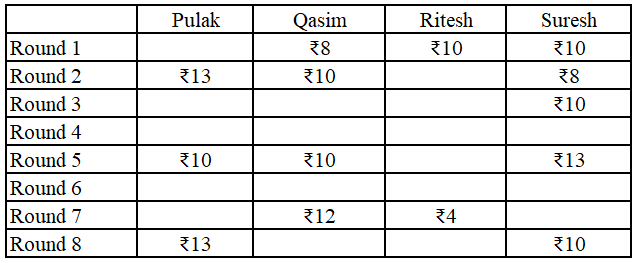
The table lists every ₹10 and every minimum and maximum, so the blank cells lie strictly between each player's extremes and are not 10:
Pulak 10–13 (blanks 11 or 12), Qasim 8–12 (blanks 9 or 11), Ritesh 4–10 (blanks 5–9), Suresh 8–13 (blanks 9, 11 or 12).
Round 4: Pulak Qasim, and the only common value is 11.
Round 1: Ritesh and Suresh are both at 10, so they paired with no money changing hands, and Pulak won ₹2 from Qasim.
Round 2 (pairs must change): Qasim +2 and Suresh −2 means Qasim beat Suresh by ₹2; Pulak beat Ritesh by ₹1.
Continuing round by round within these limits, only one sequence works:
| Round | Pairs (result) | P | Q | R | S |
|---|---|---|---|---|---|
| 1 | P beat Q ₹2; R–S no play | 12 | 8 | 10 | 10 |
| 2 | P beat R ₹1; Q beat S ₹2 | 13 | 10 | 9 | 8 |
| 3 | S beat P ₹2; Q beat R ₹1 | 11 | 11 | 8 | 10 |
| 4 | P–Q no play; S beat R ₹2 | 11 | 11 | 6 | 12 |
| 5 | S beat P ₹1; R beat Q ₹1 | 10 | 10 | 7 | 13 |
| 6 | P beat R ₹2; Q beat S ₹1 | 12 | 11 | 5 | 12 |
| 7 | P–S no play; Q beat R ₹1 | 12 | 12 | 4 | 12 |
| 8 | P beat Q ₹1; R beat S ₹2 | 13 | 11 | 6 | 10 |
What BEST can be said about the amount of money that Ritesh had with him at the end of Round 8?
Ritesh ends Round 8 with ₹6.
What BEST can be said about the amount of money that Pulak had with him at the end of Round 6?
Pulak has ₹12 after Round 6.
How much money (in ₹) did Ritesh have at the end of Round 4?
Ritesh has ₹6 after Round 4.
How many games were played with a bet of ₹2?
₹2 games: Rounds 1 (P–Q), 2 (Q–S), 3 (P–S), 4 (R–S), 6 (P–R), 8 (R–S): .
Which of the following pairings was made in Round 5?
Round 5 pairs: Pulak–Suresh and Qasim–Ritesh.
The game of Chango is a game where two people play against each other; one of them wins and the other loses, i.e., there are no drawn Chango games. 12 players participated in a Chango championship. They were divided into four groups: Group A consisted of Aruna, Azul, and Arif; Group B consisted of Brinda, Brij, and Biju; Group C consisted of Chitra, Chetan, and Chhavi; and Group D consisted of Dipen, Donna, and Deb.
Players within each group had a distinct rank going into the championship. The players have NOT been listed necessarily according to their ranks. In the group stage of the game, the second and third ranked players play against each other, and the winner of that game plays against the first ranked player of the group. The winner of this second game is considered as the winner of the group and enters a semi-final.
The winners from Groups A and B play against each other in one semi-final, while the winners from Groups C and D play against each other in the other semi-final. The winners of the two semi-finals play against each other in the final to decide the winner of the championship.
It is known that:
1. Chitra did not win the championship.
2. Aruna did not play against Arif. Brij did not play against Brinda.
3. Aruna, Biju, Chitra, and Dipen played three games each, Azul and Chetan played two games each, and the remaining players played one game each.
Each group plays 2 games (4 player-games). The group winner adds a semi-final, and the finalists one more game.
Group A: games played , so A's winner played semi and final. Aruna didn't play Arif, so Arif lost Game 1 to Azul, Azul lost to Aruna (ranked 1), and Aruna played the semi and the final.
Group B: , so B's winner lost the semi. Biju (3 games) was ranked 2 or 3: he won both group games and lost the semi to Aruna. Brij and Brinda never met, so one of them was ranked 1.
Group C: . Chitra (3 games) was ranked 1, won the semi and lost the final. Chetan beat Chhavi, then lost to Chitra.
Group D: . Dipen was ranked 2 or 3, won both group games and lost the semi to Chitra.
Final: Aruna beat Chitra.
Who among the following was DEFINITELY NOT ranked first in his/her group?
Dipen played the first group game, so he was ranked 2 or 3.
Which of the following pairs must have played against each other in the championship?
Chitra and Dipen met in the semi-final.
Who won the championship?
Aruna won the final against Chitra.
Who among the following did NOT play against Chitra in the championship?
Chitra played Chetan, Dipen and Aruna. She never played Biju.
The Hi-Lo game is a four-player game played in six rounds. In every round, each player chooses to bid Hi or Lo. The bids are made simultaneously. If all four bid Hi, then all four lose 1 point each. If three players bid Hi and one bids Lo, then the players bidding Hi gain 1 point each and the player bidding Lo loses 3 points. If two players bid Hi and two bid Lo, then the players bidding Hi gain 2 points each and the players bidding Lo lose 2 points each. If one player bids Hi and three bid Lo, then the player bidding Hi gains 3 points and the players bidding Lo lose 1 point each. If all four bid Lo, then all four gain 1 point each. Four players Arun, Bankim, Charu, and Dipak played the Hi-Lo game. The following facts are known about their game:
1. At the end of three rounds, Arun had scored 6 points, Dipak had scored 2 points, Bankim and Charu had scored -2 points each.
2. At the end of six rounds, Arun had scored 7 points, Bankim and Dipak had scored -1 point each, and Charu had scored -5 points.
3. Dipak’s score in the third round was less than his score in the first round but was more than his score in the second round.
4. In exactly two out of the six rounds, Arun was the only player who bid Hi.
Possible round results (Hi players, Lo players): 4 Hi: −1 each; 3 Hi: +1, Lo −3; 2 Hi: +2, −2; 1 Hi: +3, Lo −1; 0 Hi: +1 each.
Rounds 1–3 give (A, B, C, D) . Rounds 4–6 give .
Dipak: Round 2 Round 3 Round 1. Checking the combinations, only one works for Rounds 1–3:
| Round | Arun | Bankim | Charu | Dipak |
|---|---|---|---|---|
| 1 | Hi (+2) | Lo (−2) | Lo (−2) | Hi (+2) |
| 2 | Hi (+3) | Lo (−1) | Lo (−1) | Lo (−1) |
| 3 | Lo (+1) | Lo (+1) | Lo (+1) | Lo (+1) |
Rounds 4–6, in some order: Arun alone Hi , Bankim alone Hi , all Hi . Their sum is ✓, and Arun is the only Hi in exactly two rounds (Round 2 and one of Rounds 4–6).
What were the bids by Arun, Bankim, Charu and Dipak, respectively in the first round?
Round 1: Hi, Lo, Lo, Hi.
In how many rounds did Arun bid Hi?
Rounds 1, 2, the "Arun alone" round and the "all Hi" round: .
In how many rounds did Bankim bid Lo?
Rounds 1, 2, 3 and the "Arun alone" round: .
In how many rounds did all four players make identical bids?
Round 3 (all Lo) and the "all Hi" round: .
In how many rounds did Dipak gain exactly 1 point?
Only in Round 3 (all Lo): .
In which of the following rounds, was Arun DEFINITELY the only player to bid Hi?
Round 2 is fixed; the order of Rounds 4–6 is not.
Preparing for CAT seriously? Structured courses, live classes and mocks by Dr. Kiran Derle at Target Campus.
Explore courses ↗